Group Riding Tips
Most of these tips and tricks apply to road riding, not gravel riding. But it’s definitely educational reading, and even the most devoted gravel riders sometimes make the leap to road riding, and it never hurts to be prepared.
Introduce Yourself as a New Rider
A lot of Tripleshot riders know our routes like the back of their hands. If we know there’s a new rider in the group, we know we have to up our communication game to make sure new riders know what’s coming up and where the turns are. We’re a friendly bunch, and we’ll be happy to give you pointers and answer any questions.
No Sudden Movements
When you’re riding in a group, never hit your brakes hard, swerve, or accelerate unexpectedly (unless it’s a true emergency). Anticipate the group’s accelerations, slowings and turns by scanning ahead for hazards that might cause the lead riders to change their line. If you see or hear a hazard (a car, pothole, patch of gravel, car backing into the road, etc...), call it out or point it out so others are aware.
Keep Clear of Other Riders’ Wheels
Never creep up beside the wheel of the rider in front of you while in a paceline. That rider can’t see your front wheel, and they may drift toward it before you have time to move away. If you touch someone’s back wheel with your front wheel, it’s extremely likely that you’ll crash, and you may take others down with you. That said, don’t fixate on the wheel in front of you either–be aware of it, but keep your eyes ahead, up the road, so you can react if the group changes direction or responds to a hazard.
Skip Turns at the Front if You’re Struggling
Don’t succumb to perceived pressure to prove yourself by working hard at the front when you’re struggling. If you work too hard and burn yourself out, you’ll eventually run out of gas, slowing down the whole group. Better to take it easy and conserve energy so you can last the whole ride. Stay at the back in the draft of the group, and let the rest of the riders rotate in front of you.
Sit Out Sprints When You’re New
Some of our road rides have midride and finish sprint sections. Sprints require solid bike handling skills, and particulars of etiquette that new riders may not know about. Groups will always wait up and regroup after a sprint, so don’t feel you have to participate. Watch, learn, and ask questions (after). If you choose not to vie for a sprint, just maintain your speed and hold your line. The sprinters will pass you when it’s safe, and you can catch up when they slow down after the sprint.
Communicate, Communicate, Communicate
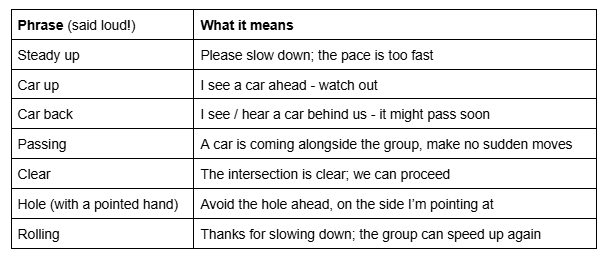
Ask questions. Point out hazards. Let riders know if you are unsure or feel nervous about something. We’re all learning here–even those who’ve ridden with Tripleshot for a decade. We all remember what it was like to be new. Call out 'Steady up!' if you need the group to slow down so you can catch up. No one wants to drop you, but everyone’s looking ahead, not back, so call it loud!
-
The following are tried-and-true tips for group road riding. They are worth reviewing, whether you’re new to group riding or an experienced veteran.
Be predictable to the riders around you. Avoid sudden changes in speed or trajectory. Brake and accelerate smoothly. Hold your line through turns. Relax and ride smoothly.
Be aware and think ahead. Look down the road—not at the wheel in front of you. Anticipate the need to slow, speed up, or change course by watching the road, upcoming intersections, potential hazards, and riders ahead of you.
Communicate effectively. Call out potential hazards or use hand signals. Always pass messages (verbal or visual) up or down the line.
Never drop a rider on a no-drop ride (all B, C rides and social rides are no-drop). Regroup after hills and sprints.
Never leave a rider on their own when they have a mechanical, especially when the weather is cold or the rider has fallen. Riders will sometimes insist on you leaving them… sometimes it’s best to insist that you’ll stay and help.
Always err on the side of safety. Winning a sprint is never worth taking a major risk.
Keep groups to a safe and courteous size–maximum 12 riders.
Never attack the group on a hazard. Riders should always slow down and wait for riders who got held back by a traffic light, turning car, wildlife or any other hazard. This is etiquette practised in the pro peloton, and for good reason. Attacking on a hazard can lead to other riders taking unnecessary risks and is unsporting.
Be polite to drivers. Don’t tailgate slow drivers or drivers who cut the group off. Don’t crowd up alongside cars at stops–wait behind them. A group of cyclists crowding in close can be intimidating to a driver, even though WE all know we’re friendly.
Be an ambassador for cycling and for Tripleshot. Each of us is responsible for improving relations between cyclists and the general public. Treat all road and trail users with patience and respect, even when it means losing some of your momentum. If you can make someone’s day brighter with a little courtesy, do it!
-
Single file paceline
Ride at the front of the line until you decide to switch, then pull off to the left and join the back of the line. If you’re in a small group with riders of mixed abilities, a single file line can often be the fastest approach. Let strong riders take long pulls at the front, and have weaker riders take short pulls or skip their pulls altogether. Having weaker riders stay at the back will give them the greatest protection from the wind.
Two-up paceline
Two lines of riders travel side by side, with the two front riders pulling off at the same time to opposite sides of the group and joining the back. One major problem with this formation is that, when the lead riders are drifting to the back, the group is temporarily 4-wide. To lessen this effect, drift back quickly, even braking briefly to speed up your trip. A brief reacceleration as you approach the back will help you reconnect to the group.
Rotating paceline
This is a two-up group that constantly rotates (usually clockwise). This works best when riders are equally matched. Because the best rotation is a smooth rotation, riders share the pulls equally. The group is more compact than a two-up paceline, because it never goes 4-wide.
Speed-dating
This is a hybrid between a two-up paceline and a rotating paceline. The group rides two-up, but after a minute or so on the front, the outside (left) lead rider pulls in front of the inside (right) lead rider, and the outside line moves up to fill the gap. The group proceeds like this for another minute or so, and the procedure is repeated. This means each rider spends about 2 minutes on the front. Advantages of this method are that 1) the group never goes 4-wide; and 2) everyone gets to spend about a minute chatting to the person next to them before moving on to the next person.
Common communication phrases in the group: